

This topic examines how strategic change can be managed in order for it to be achieved successfully.
Types of strategic change
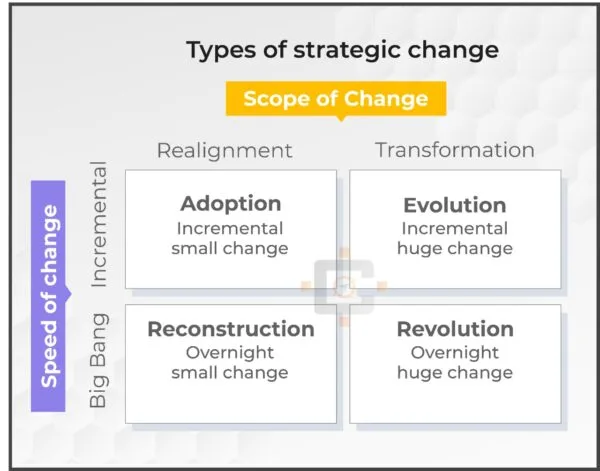
Change can be classified by the extent of the change required, and the speed with which the change is to be achieved:
This topic examines how strategic change can be managed in order for it to be achieved successfully.
Types of strategic change
Change can be classified by the extent of the change required, and the speed with which the change is to be achieved:
Adaptation:
This is the most common type of change. It is slow and gradual and is based on the existing culture, processes and competencies.
Reconstruction:
This is a much quicker change, often brought about by sudden external pressures such as a new competitor innovation or a change in the regulatory environment. The change may also be motivated by a sudden downturn in financial performance. The organisation may launch many initiatives at the same time, rather than aim for the gradual approach associated with an adaptation.
Evolution:
In anticipation of the need for future change an organisation will aim to change its culture over time. Johnson, Scholes and Whittington suggest that this can be the most challenging type of change as there is no immediate need for it but it will be vital to the long term success of the organisation. It might be best supported by a switch to a more learning organisation with a clear commitment to sustained change.
Revolution:
This involves rapid and fundamental change within an organisation. It may follow a period of strategic flux and the organisation is likely to be facing extreme external pressure for change. Culture within the organisation is likely to have to significantly adapt to new process, products, markets and objectives. Without this change in culture the change (and the organisation) will usually fail. Many new initiatives are likely to be launched simultaneously in order to reverse the organisation’s direction.
This lesson is waiting for its secure Vimeo video.


