

Types of Risks:
- Strategic risks
- Operational risks
- Business Risks
- Generic
- Specific
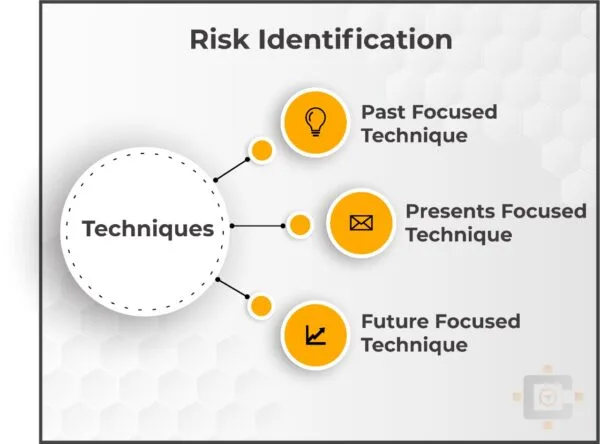
Risk Identification Technique:
- Past focused Technique
We could look at previous similar projects/operations/strategy and see what risk occurred then and could they happen now also.
We could look at checklist also. It is the list of previous uncertainties faced and now we are asking whether could they happen once again this time, and we can answer them by Yes/No/Can’t say.
- Present Focused Technique:
We could review the contract or details of our plans/project and we should find the uncertainties from those available details.
SWOT analysis, assumption analysis are also present focused technique.
- Future focused technique:
Brainstorming the future possible situations will help us find the future risks, but this will require creativity and imagination.
Scenario planning will also help us in risk identification.
Please remember not all the risk can be identified, some risks will be known over a period of time. So the risk identification is not one time process.
Risk identification: Strategic and operational risks:
Strategic risks:
– Risks arising from the possible consequences of strategic decisions taken by the organisation
– Also arise from the way that an organisation is strategically positioned within its environment
– Should be identified and assessed at senior management and board or director level
– PESTEL and SWOT techniques can be used to identify these risks.
Operational risks:
– Refer to potential losses that might arise in business operations
– Include risks of fraud or employee malfeasance, poor quality production or lack of inputs for production
– Can be managed by internal control systems.
Business Risks:
It means the uncertainty with respect to firm’s operations. It is a type of systematic risk wherein there is a volatility associated with the future income or earnings arising from events, circumstances, conditions, action, or inaction that hinders the attainment of goals and objectives and carry out the strategies.
– Market risks – Risk which derive from the sector in which the business is operating, and from its customers.
– Product risk – The risk that customers will not buy new products (or services) provided by the organisation, or that the sales demand for current products and services will decline unexpectedly.
– Commodity price risk – Businesses might be exposed to risks from unexpected increases (or falls) in the price of a key commodity.
– Product reputation risk – Some companies rely heavily on brand image and product reputation, and an adverse event could put its reputation (and so future sales) at risk.
– Credit risk – Credit risk is the possibility of losses due to non-payment, or late payment, by customers.
Generic or Specific:
– Business risks can be either generic that is the risk affects all businesses, or specific to individual business sectors.
Correlation between Risks:
– To understand risk there is a need to appreciate certain risks is related to each other. This relationship can be either positively or negatively correlated.
– Related risks are risks that vary because of the presence of another risk or where two risks have a common cause. This means when one risk increases, it has an effect on another risk and it is said that the two are related. Risk correlation is a particular example of related risk.
– Positively correlated risks are positively related in that one will fall with the reduction of the other, and increase with the rise of the other.
– Negatively correlated risks are negatively related in that one rises as the other falls.
– The Deepwater Horizon oil spill in 2010 clearly had a huge environmental impact but also severely affected BP’s reputation. This relationship would be described as a positive correlation. As one risk increases, so does the other.
– A negative correlation would see the risks moving in opposite directions. For example, as BP spends more money to limit the risk of environmental damage, the company would also be depleting its cash reserves substantially and thus increasing its financial risk.
Market risks:
– Resource (not being able to obtain the required inputs)
– Production (risks in poor manufacturing, etc.)
– Capital markets (not being able to obtain necessary finance)
– Liquidity (the risk of having insufficient cash for the day-to-day running of the business).
Product risk:
– The demand for 3G mobile communications services grew much slower than expected by the mobile telephone service providers, due partly to the sluggish development of suitable mobile phone handsets of its credit rating.
Commodity price risk:
– Airlines are exposed to the risk of increases in fuel prices, particularly when market demand for flights is weak, and so increases in ticket prices for flights are not possible.
Product reputation risk:
– Risk to a product’s reputation could arise from adverse public attitudes to a product or from negative publicity: this has been evident in Europe with widespread hostility to genetically-modified (GM) foods.
Credit risk:
– The total volume of credit sales
– The organisation’s credit policy
– Credit vetting and assessment procedures.
Generic or Specific:
– Changes in the interest rate, noncompliance with company law, or poor use of derivative instruments.
– Generic risks can also affect different businesses in different ways; a company with substantial borrowing will be affected more by an increase in interest rates than a company with little or no borrowings.
– Similarly, a company manufacturing computers will be more at risk from the possibility of changes in legislation affecting VDUs than a company providing legal services.
Correlation between Risks:
– Positive Correlation: As the Environmental risk increases so does the Reputational risk.
– Negative Correlation: As more money is spent on reducing the Environmental damage, therefore reducing the risk. There is an increase in the financial risk facing the company.
This lesson is waiting for its secure Vimeo video.


