

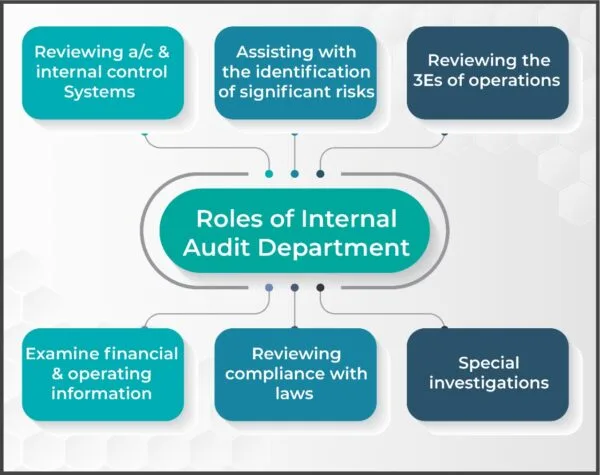
Reviewing accounting and internal control Systems (financial audit)
Assisting with the identification of significant risks
Reviewing the economy, efficiency and effectiveness of operations (operational audit)
Examining financial and operating information
Special investigations
Reviewing compliance with laws and other external regulations
Reviewing accounting and internal control Systems (financial audit):
This is the traditional view of internal audit. The internal auditor checks the financial controls in the company, possibly assisting or sharing work with the external auditor. The internal auditor would comment on whether appropriate controls exist as well as whether they are working correctly. In this work, the internal auditor does not manage risk, but simply reports on controls.
Assisting with the identification of significant risks:
In this function, the internal auditor does start to work on risks. The auditor may be asked to investigate areas of risk management, with specific reference on how the company identifies, assesses and controls significant risks from both internal and external sources.
Reviewing the economy, efficiency and effectiveness of operations (operational audit):
This is also called a value for money (VFM) audit. The auditor checks whether a particular activity is cost effective (economical), uses the minimum inputs for a given output (efficient) and meets its stated objectives (effective).
Examining financial and operating information:
Internal auditors ensure that reporting of financial information is made on a timely basis and that the information in the reports is factually accurate.
Special investigations:
Investigations into other areas of the company’s business, e.g. checking the cost estimates for a new factory.
Reviewing compliance with laws and other external regulations:
This objective is particularly relevant regarding SOX where the internal auditor will be carrying out detailed work to ensure that internal control systems and financial reports meet stock exchange requirements.
Key activities include:
– Collating, checking and analysing spreadsheet data
– Examining company accounts and financial control systems
– Evaluating levels of financial risk within organisations
– Checking that financial reports and records are accurate and reliable
– Ensuring that assets are safeguarded
– Identifying if and where processes are not working as they should and advising on changes to be made
– Liaising with managerial staff and presenting findings and recommendations
– Ensuring procedures, policies, legislation and regulations are correctly followed and complied.
This lesson is waiting for its secure Vimeo video.


