

Self-interest threat
Occurs when the audit firm or a member of the audit team could benefit from a financial interest in, or other self-interest conflict with, an audit client.
Self-review threat
Occurs when the audit firm, or an individual audit team member, is put in a position of reviewing subject matter for which the firm or individual was previously responsible, and which is significant in the context of the audit engagement.
Advocacy threat
It arises when auditor (most of the time unintentionally) supports the opinion or position (of the client most of the time) to the extent that it is not supported with relevant evidence or simply auditor supported the opinion beyond the degree of objectivity.
Familiarity threat
Occurs when, by virtue of a close relationship with an audit client, its directors, officers or employees, an audit firm or a member of the audit team becomes too sympathetic to the client’s interests.
Intimidation threat
Occurs when a member of the audit team may be deterred from acting objectively and exercising professional scepticism by threats, actual or perceived, from the directors, officers or employees of an audit client.
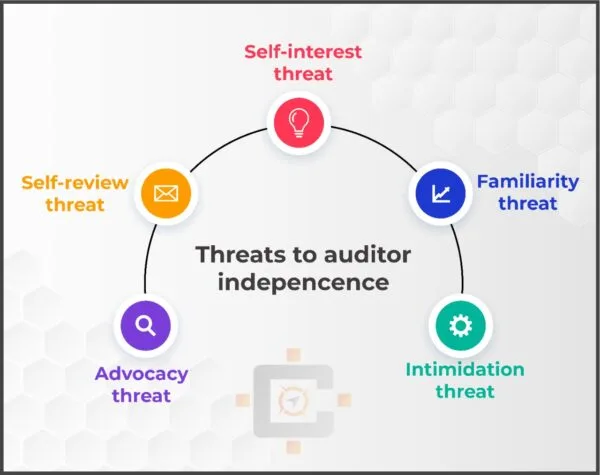
Auditor independence will be compromised where ethical threats are faced.
A threat to independence is anything that means that the opinion of an auditor could be doubted.
Threats can be real or perceived.
The conceptual framework in the ACCA code of ethics provides examples of generic threats that affect auditors, which can be viewed as affecting both external and internal auditors.
Self-interest threat:
Occurs when the audit firm or a member of the audit team could benefit from a financial interest in, or other self-interest conflict with, an audit client.
Self-review threat:
Occurs when the audit firm, or an individual audit team member, is put in a position of reviewing subject matter for which the firm or individual was previously responsible, and which is significant in the context of the audit engagement.
Advocacy threat:
Occurs when the audit firm, or a member of the audit team, promotes, or may be perceived to promote, an audit client’s position or opinion.
Familiarity threat:
Occurs when, by virtue of a close relationship with an audit client, its directors, officers or employees, an audit firm or a member of the audit team becomes too sympathetic to the client’s interests.
Intimidation threat:
Occurs when a member of the audit team may be deterred from acting objectively and exercising professional scepticism by threats, actual or perceived, from the directors, officers or employees of an audit client.
Self-interest threat:
– Direct financial interest or material indirect financial interest in an audit client
– Loan or guarantee to or from an audit client or any of its directors or officers
– Undue dependence on total fees from an audit client
Self-review threat:
– Member of the audit team being, or having recently been, a director, officer or other employee of the audit client in a position to exert direct and significant influence over the subject matter of the audit engagement
– Performing services for an audit client that directly affect the subject matter of the current, or a subsequent, audit engagement and
– Preparing original data used to generate financial statements or preparing other records that are the subject matter of the audit engagement.
Advocacy threat:
– Dealing in, or being a promoter of, shares or other securities in an audit client, and
– Acting as an advocate on behalf of an audit client in litigation or in resolving disputes with third parties.
Familiarity threat:
– A member of the audit team having a close family member who, as a director, officer or other employee of the audit client, is in a position to exert direct and significant influence over the subject matter of the audit engagement
– A former partner of the firm being a director, officer or other employee of the audit client, in a position to exert direct and significant influence over the subject matter of the audit engagement
– Long association of a senior member of the audit team with the audit client
Intimidation threat:
– Threat of replacement over a disagreement regarding the application of an accounting principle
– Pressure to reduce inappropriately the extent of work performed in order to reduce fees and
– Dominant personality in a senior position at the audit client, controlling dealings with the auditor.
This lesson is waiting for its secure Vimeo video.


