

Board Structures – Two Tier Board:
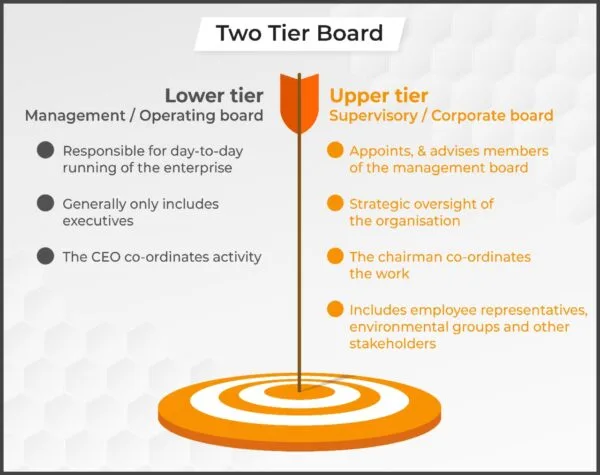
Lower tier: management (operating) board:
– Responsible for day-to-day running of the enterprise
– Generally only includes executives
– The CEO co-ordinates activity.
Upper tier: supervisory (corporate) board:
– Appoints, supervises and advises members of the management board
– Strategic oversight of the organisation
– Includes employee representatives, environmental groups and other stakeholders’ management representatives (these NEDs are not considered to be ‘independent NEDs’)
– The chairman co-ordinates the work
– Members are elected by shareholders at the annual general meeting (AGM)
Organizational theorists generally agree that the duties of a board can be divided into three categories: control, strategy, and service. Under the governance of a one-tiered board (Unitary), directors are expected to perform all three roles. In a two-tiered system, strategy and service are executed by the management board while the supervisory board while the control is handled by the supervisory board.
Advantages:
– Clear separation between those that manage the company and those that own it or must control
– Wider stakeholder involvement implicit through the use of worker representation.
Disadvantages:
– Dilution of power
– Isolation of supervisory board through non-participation in management meetings.
– Increased bureaucracy which may result in slower decisions being made.
– Lack of transparency over appointment of supervisory board members leading to inefficient monitoring and governance.
Board Structures – One Tier Board/Unitary Board:
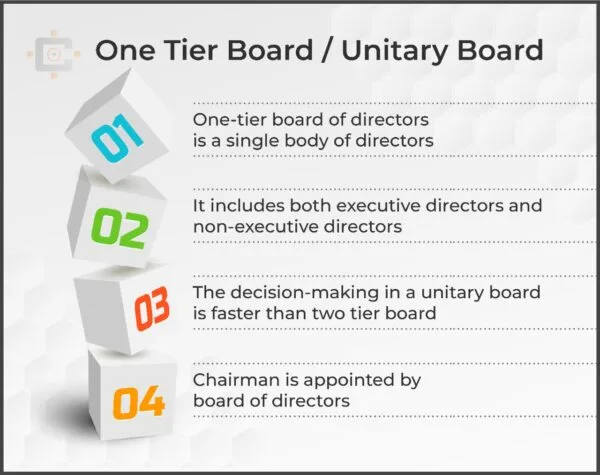
One-tier board of directors (also known as unitary board of directors) is a single body of directors that makes strategic decisions of a company. It includes both executive directors and non-executive directors.
The unitary board of directors is composed of executive directors (employees of the company) and non-executive directors (independent external directors). Both these directors sit on a single board and so that’s why there is no clear separation of duties among those ED & NEDs.
As all directors sit on a single board, the decision-making in a unitary board gets faster.
In Unitary Board, Chairman is appointed by board of directors to manage the Board meetings.
Advantages:
– Benefit of expertise of NEDs as they are also be involved in the board meetings.
– NED is independent but they are also as responsible as Executive directors.
– Half of the board are executive directors who are associated with actual management of the company and so it will give better decision making.
This lesson is waiting for its secure Vimeo video.


